

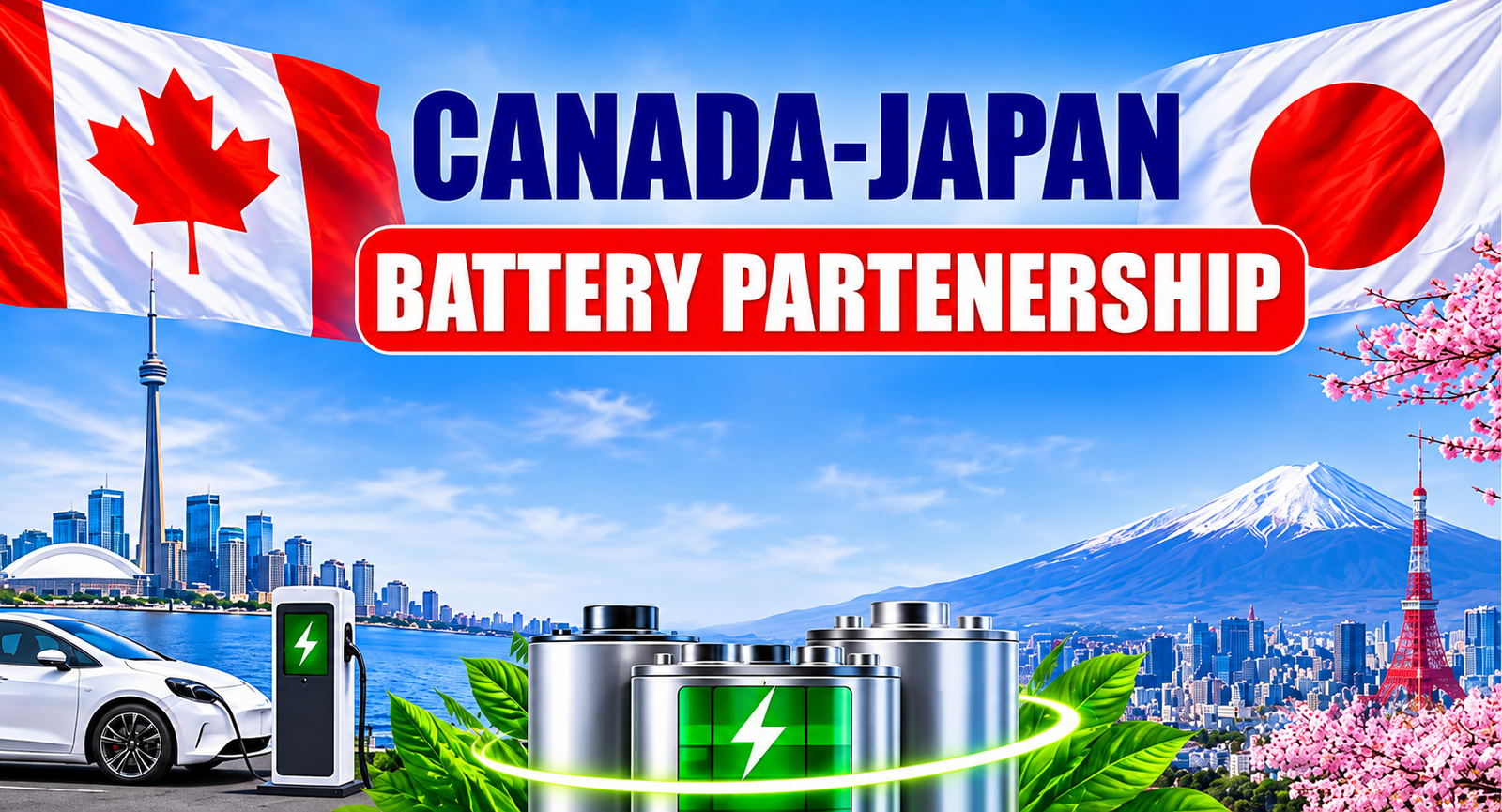
Canada and Japan are looking to strengthen cooperation across the battery supply chain as demand for electric vehicles and clean energy technologies increases. Government officials and industry representatives from both countries met in Ottawa on November 16, 2026, for discussions on battery manufacturing, research, trade and investment.
The meeting marked the third Canada-Japan Battery Supply
Chain Dialogue and Industry Roundtable. Both countries reaffirmed their
commitment to developing reliable and sustainable battery supply chains.
However, the discussions focused on future cooperation
rather than announcing a new manufacturing project or investment deal.
What Happened at the Canada-Japan Battery Meeting?
The government dialogue was co-chaired by Sara Wilshaw,
Senior Assistant Deputy Minister of International Trade and Chief Trade
Commissioner at Global Affairs Canada, and Takayanagi Daisuke, Deputy
Director-General at Japan's Ministry of Economy, Trade and Industry.
Officials discussed Canada's automotive, electricity and
critical minerals strategies alongside Japan's updated battery strategy and
industrial priorities.
Research and development was another important topic. Both
sides highlighted existing cooperation between their research institutions and
explored opportunities to expand collaboration in battery evaluation and
research.
A separate industry roundtable brought together Canadian and
Japanese companies involved in battery manufacturing, materials and minerals.
Japan's Battery Association for Supply Chain also participated.
The discussions aimed to identify potential commercial
partnerships and investment opportunities across the battery industry.
Readers can find the details in the official
Global Affairs Canada announcement.
Why Is Japan Important to Canada's Battery Industry?
Japan is an important trading and investment partner for
Canada.
According to Global Affairs Canada, Japan was Canada's
fifth-largest merchandise trading partner in 2025. Canadian exports to Japan
reached C$14.6 billion, while imports from Japan totalled C$21.1 billion.
Japanese foreign direct investment in Canada was valued at
C$54.8 billion in 2025, making Japan Canada's largest investment source from
the Indo-Pacific region.
Japan's established automotive and advanced manufacturing
industries could complement Canada's mineral resources and growing battery
sector.
Closer cooperation may help Canada attract investment,
develop its critical minerals industry and strengthen its position in
international clean technology markets.
How Could the Partnership Benefit Electric Vehicle
Manufacturing?
Battery production requires several interconnected
industries, including mineral extraction, materials processing, manufacturing
and technology development.
Canada has access to important mineral resources, while
Japan has considerable experience in automotive manufacturing and battery
technology.
Working together could create opportunities for Canadian
companies to supply battery materials and minerals, while Japanese businesses
could contribute manufacturing expertise and research capabilities.
Cooperation in battery testing and evaluation could also
support future technology development.
Canada's wider automotive expansion plans, including Chery's
proposed entry into the Canadian market in 2027, also highlight the
country's interest in attracting international automotive manufacturers.
However, these remain potential benefits. The November
meeting did not confirm any specific manufacturing investment or joint
production project.
What Does This Mean for Global Battery Supply Chains?
Countries are increasingly looking to diversify battery
supply chains to reduce dependence on limited sources of minerals, materials
and manufacturing capacity.
Canada-Japan cooperation could help both countries build
stronger international partnerships across different stages of battery
production.
The discussions also extend beyond electric vehicles.
Battery technology plays an important role in energy storage and the
development of cleaner electricity systems.
For Canada, the partnership supports efforts to expand trade
relationships in the Indo-Pacific region. For Japan, closer ties with Canadian
businesses could provide additional opportunities across the international
battery industry.
The two countries had already established a framework for
this cooperation through their Memorandum
of Cooperation on Battery Supply Chains, which covers critical minerals,
investment, research and technology development.
What Happens Next?
The third Canada-Japan Battery Supply Chain Dialogue
reaffirmed both countries' interest in expanding cooperation across the battery
value chain.
The next step will be turning these discussions into
practical outcomes, such as research agreements, commercial partnerships,
investment projects or long-term supply arrangements.
For now, no new battery factory or specific investment
amount has been announced.
Whether the partnership delivers tangible results will
depend on how effectively businesses and governments translate their shared
priorities into long-term industrial cooperation.


Discussion & Comments (0)
No comments yet. Be the first to share your thoughts on this story!
Leave a Comment