

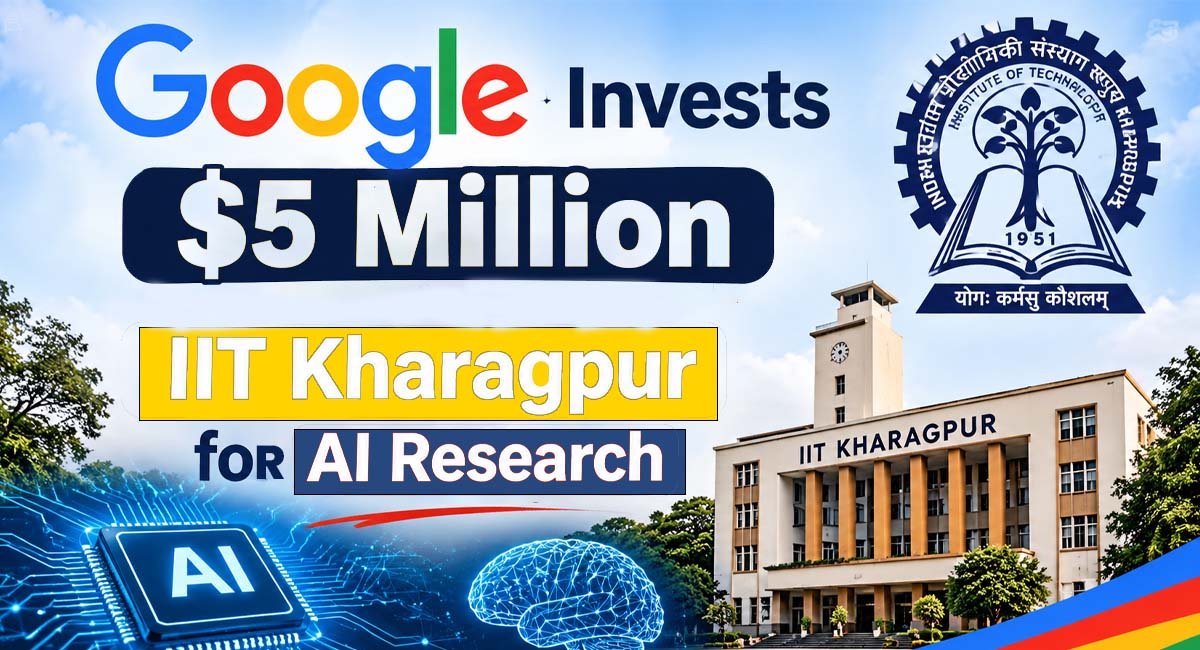
Google has announced $5 million (approximately ₹46 crore) in funding for the Indian Institute of Technology (IIT) Kharagpur to support artificial intelligence research, expand educational opportunities and strengthen the institute's AI infrastructure.
The announcement was made on November 21, 2026, during IIT
Kharagpur's 75th anniversary celebrations. Google CEO Sundar Pichai, an alumnus
of the institute, announced the partnership through an official
Google blog post.
The funding will support researchers and students working on
practical AI applications, with a focus on four areas: Indian languages,
materials science, agriculture and educational technology.
However, the initiative goes beyond research. Google has
also outlined plans to expand AI training and curriculum development for
students, faculty members and teachers.
Why Is Google Investing in IIT Kharagpur?
IIT Kharagpur is one of India's leading technical
institutions, with a long history of research and engineering education. The
partnership also has a personal connection with Sundar Pichai, who studied
Metallurgical Engineering at the institute.
In the announcement, Pichai highlighted IIT Kharagpur's work
in areas such as Indian languages, agriculture and education. He said Google
wanted to help accelerate this research and create opportunities for the next
generation of students.
The funding is intended to support applied research and
strengthen the institute's technological capabilities. Rather than focusing
only on theoretical work, the partnership aims to help researchers explore AI
applications that address practical challenges.
Readers can learn more about the institute's research and
academic programmes through the official
IIT Kharagpur website.
Four Areas That Will Receive AI Research Support
Google has identified four research areas under the advanced
AI research component of the partnership.
1. Artificial Intelligence for Indian Languages
India's linguistic diversity creates challenges for people
accessing digital services that primarily operate in English.
AI research in Indic languages could support better
translation systems, speech recognition and language-based applications.
For example, improved language models could make it easier
for people to interact with digital platforms in Hindi, Punjabi, Bengali, Tamil
and other Indian languages.
Such developments could help make digital services more
accessible to people who are less comfortable using English.
2. AI Applications in Agriculture
Agriculture is another important area of the partnership.
Researchers can explore how AI can analyse agricultural
data, identify crop-related problems and support better farming decisions.
Potential applications include image-based crop disease
detection, weather analysis and tools that help farmers understand changing
field conditions.
These technologies could eventually support more informed
agricultural decisions. However, their practical value will depend on how
accurately they perform across different crops, regions and farming conditions.
3. AI Research in Materials Science
Materials science is important to industries such as
electronics, manufacturing, healthcare and renewable energy.
AI can help researchers analyse scientific datasets,
identify patterns in material properties and narrow down potential materials
for further experiments.
This research could support work involving advanced
batteries, electronic components and other industrial technologies.
Combining AI with traditional scientific research may also
help researchers explore complex problems more efficiently.
4. AI in Educational Technology
Educational technology is the fourth research area
identified by Google.
AI-powered learning tools could support personalised
explanations, interactive study experiences and digital educational resources.
These technologies may also help teachers prepare learning
materials and organise classroom activities.
The partnership will additionally support the expansion of
AI training and curriculum development, helping students and educators build
skills related to artificial intelligence.
Three Major Pillars of Google's Funding
Although the research component covers four subjects, the
overall partnership is organised around three broader pillars.
Advanced AI research: Supporting applied research in
Indic languages, materials science, agriculture and educational technology.
Educational opportunities: Expanding AI training and
curriculum development for students, faculty members and teachers.
AI capacity building: Strengthening IIT Kharagpur's
AI frameworks and tools to improve its technological ecosystem across the
campus.
This structure is important because the funding is not
limited to individual research projects. It also aims to improve the
institute's ability to develop AI knowledge, train people and support future
research.
What Could Students and Researchers Gain?
The education component could create opportunities for
students and faculty members to engage with artificial intelligence through
expanded training and curriculum development.
Researchers may also benefit from stronger institutional AI
capabilities and opportunities to work on applied projects across the four
identified fields.
However, Google has not yet announced specific course names,
admission procedures, scholarship opportunities or programme launch dates.
Therefore, students should not interpret the funding
announcement as confirmation of a new scholarship or an immediately available
AI course.
The actual opportunities will become clearer when IIT
Kharagpur shares details about the programmes and projects developed under the
partnership.
How Does This Fit Into India's AI Development Plans?
India has been investing in AI research, computing
infrastructure and technical skills through several national initiatives.
One of the major programmes is the IndiaAI Mission,
which received Cabinet approval in March 2024 with a total budget of ₹10,371.92
crore over five years. The mission supports AI computing capacity, indigenous
AI development, datasets, application development, future skills and
responsible AI.
The government's official
announcement of the IndiaAI Mission explains its broader objectives.
Google's partnership with IIT Kharagpur adds a
private-sector contribution to this wider research ecosystem. Its focus on
Indian languages, agriculture and educational technology is particularly
relevant to challenges that extend beyond the technology industry.
The development also reflects the growing role of academic
institutions in India's AI ambitions. IITs and other research organisations can
help connect scientific research with practical applications, while
collaborations with technology companies may provide additional resources and
expertise.
What Has Been Announced and What Is Still Unknown?
Google has confirmed the $5 million funding commitment and
identified the three broad pillars of the partnership.
However, several implementation details remain undisclosed:
- Project-wise
allocation of the $5 million.
- Names
of individual research projects.
- Specific
AI courses or training programmes.
- Eligibility
and application procedures for students.
- The
implementation schedule for different initiatives.
The next important step will be how IIT Kharagpur translates
these priorities into research projects, training opportunities and
campus-level resources.
For now, the announcement represents a funding commitment
towards AI research, education and institutional capacity building, rather than
the launch of a specific public AI programme.


Discussion & Comments (0)
No comments yet. Be the first to share your thoughts on this story!
Leave a Comment