

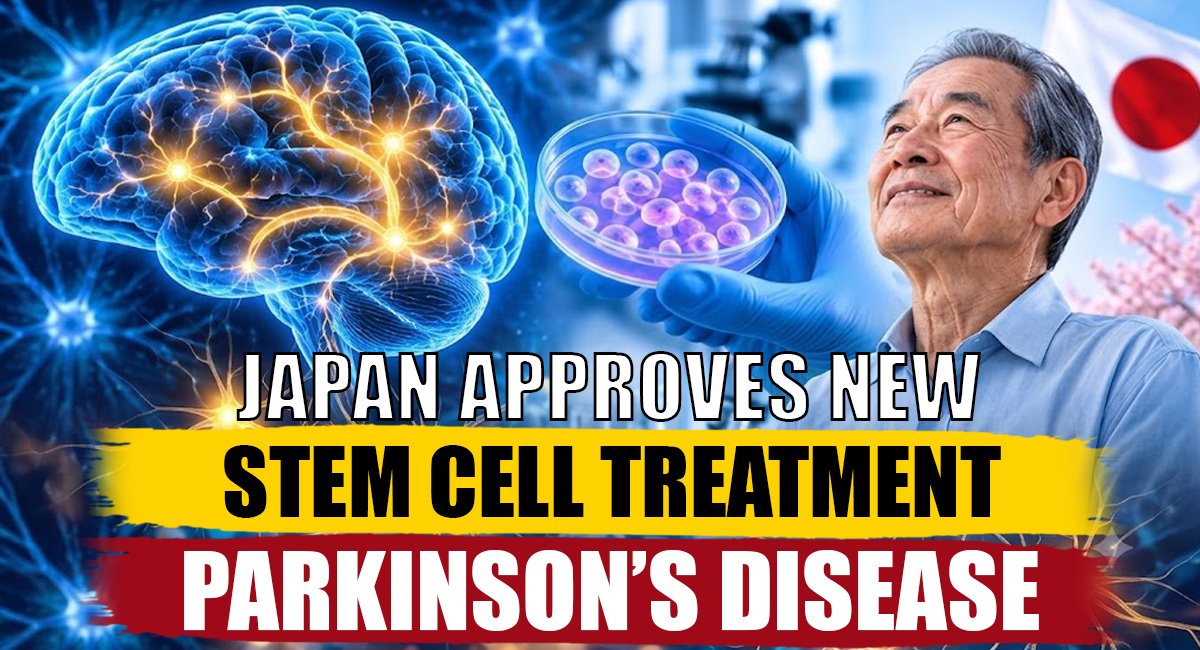
Japan has taken an important step in medical science with a
new treatment for Parkinson’s disease. Researchers have developed a
stem-cell-based therapy that aims to replace damaged brain cells responsible
for producing dopamine. The treatment has received conditional approval in
Japan and could offer a new option for people living with Parkinson’s disease.
The therapy was developed through research led by Kyoto
University. It uses special cells made from induced pluripotent stem cells,
also known as iPS cells. These cells are designed to develop into
dopamine-producing neurons and help improve movement problems caused by the
disease.
What Is Parkinson’s Disease?
Parkinson’s disease is a brain disorder that affects a
person's ability to control body movements. It develops when certain brain
cells stop working properly or die. These cells normally produce dopamine, a
chemical that helps control movement.
When dopamine levels become low, people may experience
shaking hands, stiff muscles, slow movements and problems with balance. The
condition can also affect daily activities such as walking, writing and
speaking.
There are medicines that help control these symptoms, but
they do not replace the damaged brain cells. This is why researchers have been
looking for new ways to treat the condition.
How Does Japan's New Stem Cell Treatment Work?
The new therapy uses induced pluripotent stem cells, which
are special cells that can develop into different types of cells in the body.
Researchers at Kyoto University used these stem cells to
create dopamine-producing neuron precursor cells. These cells were then
transplanted into both sides of the patients' brains.
The transplant was carried out in an area called the
putamen, which plays an important role in controlling movement. The main aim
was to help the brain produce dopamine again by allowing the transplanted cells
to develop into working dopamine-producing neurons.
The treatment was tested using two different doses. Patients
in the low-dose group received around 2.1 to 2.6 million cells in each side of
the brain, while those in the high-dose group received around 5.3 to 5.5
million cells per side.
What Were the Results of the Clinical Trial?
The clinical trial included seven patients between the ages
of 50 and 69. Researchers monitored them for 24 months to study the safety and
possible benefits of the treatment.
Six patients were included in the main effectiveness
evaluation. Four of them showed improvements in motor symptoms, while five
showed improvements in their movement scores when taking their regular
Parkinson's medication.
The researchers also found increased dopamine activity in
the treated areas of the brain. Brain scans did not show abnormal growth of the
transplanted cells.
No serious adverse events were reported during the study.
However, researchers recorded 73 mild-to-moderate adverse events among the
seven patients. This means the treatment still needs careful monitoring.
The complete findings were published in the scientific
journal Nature on
April 16, 2025.
Japan Grants Approval to the New Treatment
After studying the clinical trial results, Japan took
another major step towards making this treatment available.
On March 6, 2026, Japan granted conditional and time-limited
approval to the therapy. It is named AMCHEPRY and is also known by its generic
name, raguneprocel.
The treatment was developed by Sumitomo Pharma with support
from Kyoto University researchers and RACTHERA. It is intended for Parkinson's
patients whose motor symptoms do not respond well enough to existing medicines,
including treatments containing levodopa.
This approval is important because AMCHEPRY became the
world's first approved regenerative medicine product based on iPS cells.
However, the approval comes with certain conditions. The
company must continue studying the treatment after its launch and collect more
information about its safety and effectiveness before seeking full approval.
Readers can find more information in the official
announcement by Sumitomo Pharma and RACTHERA.
First Transplant Surgeries Begin in Japan
The treatment has now moved beyond the approval stage. Kyoto
University Hospital announced on October 30, 2026, that it had started
transplant surgeries using AMCHEPRY.
The first reported patient was a woman in her 50s who
underwent the procedure in October. According to the hospital, her recovery
after surgery was good and she had already been discharged.
Doctors will continue to monitor her condition to understand
how well the transplanted cells work and whether the treatment provides lasting
benefits.
The hospital has shared this update through its official announcement
about the first transplant surgeries.
What Does This Mean for Parkinson's Patients?
The development could bring a new treatment option for
people who do not get enough relief from existing Parkinson's medicines.
Most current treatments focus on managing symptoms. This new
approach is different because it aims to replace some of the damaged cells
responsible for producing dopamine.
If further studies confirm its benefits, the treatment could
change how doctors manage Parkinson's disease in the future.
However, it is important to understand that this is not a
confirmed cure. The clinical trial involved a small number of patients, and
researchers still need more information about its long-term results.
Conclusion
Japan's new stem-cell-based treatment is an important
development in the field of regenerative medicine. The clinical trial showed
improvements in movement symptoms among several patients, and the treatment has
now received conditional approval.
With the first transplant surgeries already underway,
researchers will have more opportunities to study its effects in real-world
medical settings.
Although there is still a long way to go, this development
has given fresh hope to people living with Parkinson's disease and their
families.



Discussion & Comments (0)
No comments yet. Be the first to share your thoughts on this story!
Leave a Comment