

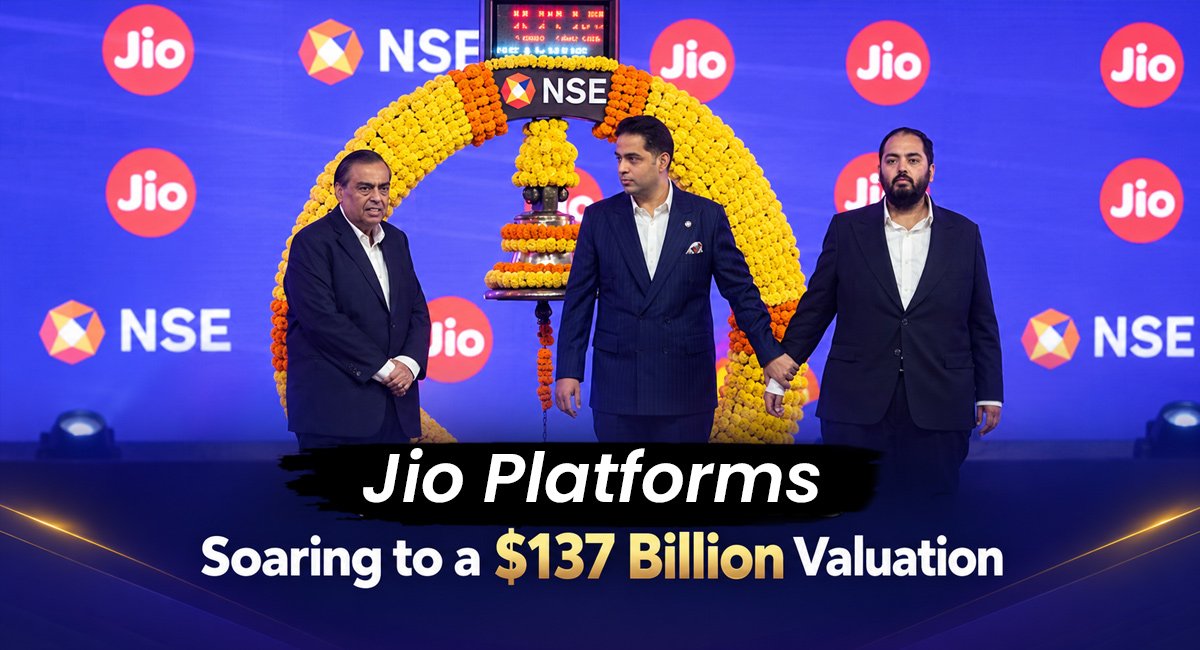
Jio Platforms has made a strong entry into the Indian stock market. The company started trading on October 28, 2026, and received a positive response from investors. Its shares rose sharply on the first day, taking its market value to around $137 billion.
With this achievement, Jio Platforms became India's second
most valuable listed company after its parent company, Reliance Industries. The
successful debut has also brought fresh attention to India's telecom and
digital services industry.
Jio Platforms Shares Rise on Listing Day
Jio Platforms shares were listed on the stock exchanges at
Rs 1,358 per share. This was around 21.4% higher than the IPO issue price of Rs
1,119.
The shares continued to gain during the trading session and
closed at around Rs 1,417.50 on the National Stock Exchange. This was a rise of
about 26.7% from the issue price.
According to a Reuters
report on Jio Platforms' market debut, the strong performance pushed the
company's market value to approximately $137 billion.
The result made Jio one of the most valuable telecom
companies in the world. It also placed the company ahead of Bharti Airtel in
terms of market capitalisation.
Jio Platforms Becomes India's Second Most Valuable
Company
Jio Platforms reached a market capitalisation of around Rs
13.05 lakh crore after its first day of trading. Only Reliance Industries had a
higher market value among listed Indian companies.
This is an important milestone for the Reliance Group. Jio
has grown from a telecom business into a wider digital services company. Its
services include mobile connectivity, broadband and other technology-based
solutions.
As reported by Business
Standard, the strong debut also changed the ranking of India's largest
listed companies.
The listing has given investors a direct way to buy shares
in Jio Platforms instead of getting exposure to its business only through
Reliance Industries.
India's Largest IPO Attracts Strong Investor Interest
Jio Platforms raised around Rs 30,213 crore through its
initial public offering, also known as an IPO. The issue attracted strong
demand from investors before the shares entered the market.
The IPO received bids for more than 22 times the number of
shares available. This showed strong interest from institutional and other
investors.
The offering was also an important step for Reliance
Industries, which had not launched a public offering from its group since 2006.
According to Reuters'
report on the IPO, the company attracted major investor interest ahead of
its stock market debut.
However, a strong listing does not mean that the share price
will continue to rise. Market prices can change with business performance,
investor sentiment and wider economic conditions.
What Makes Jio Platforms Important?
Jio entered India's telecom market in 2016 with affordable
data plans and voice services. Its entry changed the way millions of people
accessed mobile internet.
The company now serves more than 530 million customers
through its telecom business. It is also working across broadband and digital
technology services.
Jio's large customer base gives it an opportunity to expand
its services. Growing demand for high-speed internet, cloud computing and
artificial intelligence could create new business opportunities in the coming
years.
At the same time, the company faces competition from other
telecom operators. It also needs to keep investing in its network and
technology to meet customer demand.
What Comes Next for Jio Platforms?
The successful listing is a major step for Jio Platforms. It
has given the company a separate market value and increased public interest in
its business.
Investors will now watch its financial results, customer
growth and plans for new services. Its ability to turn its large customer base
into higher revenue will also remain important.
For now, Jio Platforms has made a strong start in the stock
market. Its next challenge will be to maintain business growth and deliver
results that support investor expectations.
Disclaimer: This article is for informational
purposes only and does not provide investment advice.


Discussion & Comments (0)
No comments yet. Be the first to share your thoughts on this story!
Leave a Comment