

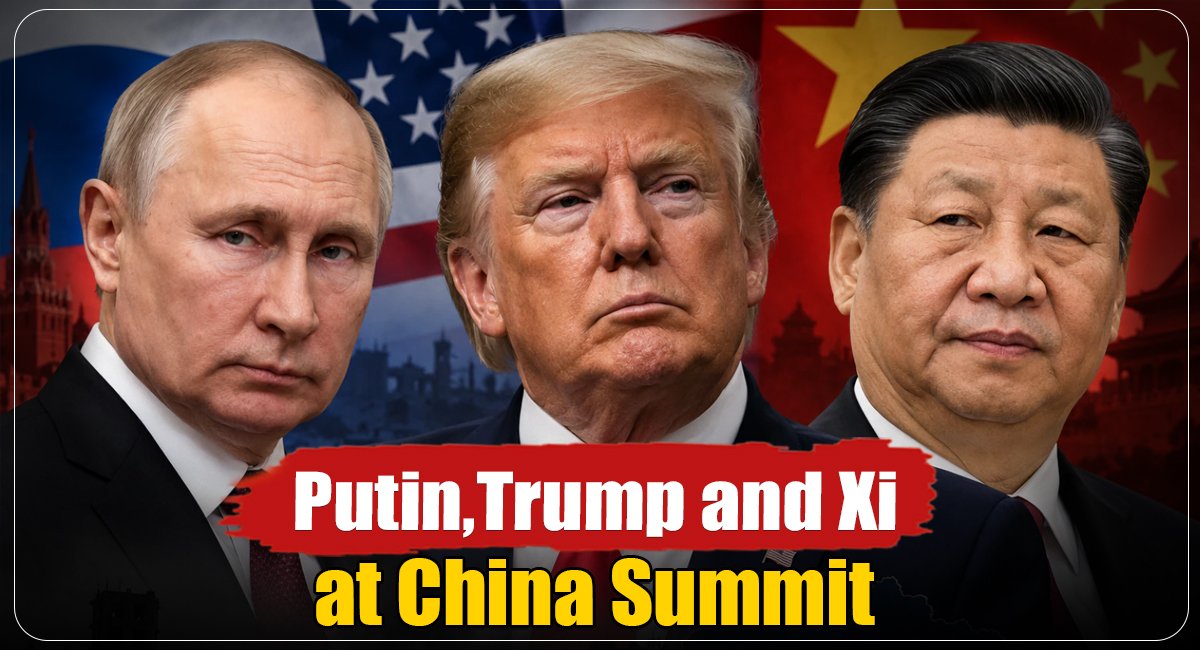
US President Donald Trump, Chinese President Xi Jinping and Russian President Vladimir Putin are scheduled to meet in Shenzhen, China, on November 19, 2026. The trilateral summit will take place alongside the 33rd Asia-Pacific Economic Cooperation (APEC) Economic Leaders' Meeting.
The gathering brings together three of the world's most
influential leaders at a time of growing international tensions. Nuclear
weapons, the conflict involving Iran, Russia's war in Ukraine and US-China
competition are among the major issues surrounding the meeting.
One of the biggest concerns is the future of nuclear arms
control. The New START treaty between the United States and Russia expired in
February 2026, ending the last major agreement that placed limits on their
strategic nuclear arsenals.
However, expectations of a major breakthrough remain
limited. The three countries have different positions on nuclear restrictions,
regional conflicts and international security. The Shenzhen meeting could open
the door to further diplomatic discussions, but reaching concrete agreements
will be considerably more difficult.
Why Are Trump, Xi and Putin Meeting in China?
China's Foreign Ministry officially confirmed the trilateral
summit on November 16. According to its official
announcement, Xi Jinping will host Trump and Putin in Shenzhen on November
19.
The Chinese government said the three leaders would exchange
views on safeguarding world peace and promoting strategic stability in
relations among major powers. It also described the gathering as the first
face-to-face meeting involving the three countries' heads of state in this
format.
The timing is important because the 33rd
APEC Economic Leaders' Meeting is scheduled to take place in Shenzhen from
November 18 to 19.
The summit gives Washington, Beijing and Moscow an
opportunity to communicate directly about international security. However,
their priorities are not necessarily the same.
Trump wants to discuss nuclear weapons and the situation
involving Iran. Putin has an interest in discussions concerning Ukraine, while
Xi is looking to strengthen China's diplomatic position and maintain stable
relations with both countries.
China has not published a detailed, jointly agreed agenda
for the trilateral meeting.
Nuclear Weapons Control Could Be the Biggest Challenge
Nuclear arms control is expected to be one of the most
important subjects at the Shenzhen summit.
The New START treaty, which governed strategic nuclear
weapons restrictions between the United States and Russia, expired on February
5, 2026.
The agreement placed limits on deployed strategic nuclear
weapons and included verification arrangements that helped both countries
monitor compliance. Its expiration removed an important framework for
transparency and arms control between the two largest nuclear powers.
The United
Nations Secretary-General's statement on New START's expiration highlighted
the risks created by the absence of binding limits on American and Russian
strategic nuclear arsenals.
Trump has expressed interest in negotiating a new nuclear
agreement that could also include China.
However, Beijing has been reluctant to participate in
negotiations based on the existing US-Russia framework. China argues that
Washington and Moscow possess significantly larger nuclear arsenals and should
take the lead in reducing their stockpiles.
According to the Stockholm International Peace Research
Institute (SIPRI), estimated total nuclear inventories in January 2026 were:
|
Country |
Estimated Nuclear Warheads |
|
Russia |
5,420 |
|
United States |
5,042 |
|
China |
620 |
These figures include different categories of nuclear
weapons, including deployed, stored and retired warheads. They should not be
interpreted as the number of weapons currently deployed.
Readers can check the SIPRI Global
Nuclear Weapon Inventories report for the country-wise estimates.
The difference in arsenal sizes highlights the difficulty of
creating a three-country agreement. China may resist restrictions designed
around the existing US-Russia arrangement, while Washington wants any future
framework to address China's expanding nuclear capabilities.
The Shenzhen summit could provide an opportunity to discuss
future negotiations, but a comprehensive agreement would require further
technical discussions and long-term commitments.
Will the Ukraine War Be Discussed?
Russia's war in Ukraine remains an important issue
surrounding the meeting, although it is not expected to be a central subject of
the formal trilateral discussion.
US officials have indicated that Ukraine is unlikely to
feature prominently in the three-way talks. However, Moscow has shown interest
in discussing the conflict with Washington.
Trump has repeatedly expressed interest in finding a way to
end the war. Putin, meanwhile, continues to defend Russia's position and has
its own conditions for any potential settlement.
China has previously maintained that European countries
should have an important role in discussions concerning the Ukraine conflict.
This distinction matters because Ukraine's future cannot be
separated from questions involving its territory, security arrangements and
political independence.
The possibility of major powers discussing the conflict
without Ukraine's direct participation has also raised concerns among Kyiv and
its European partners.
Even if the issue is not a central part of the Shenzhen
meeting, it could remain important in separate diplomatic discussions between
the countries.
Iran and Middle East Security Add to the Agenda
The conflict involving Iran is another issue Trump intends
to raise during his discussions with Xi and Putin.
The situation has wider international implications because
developments in the Middle East can affect energy supplies, oil prices and
regional security.
China maintains diplomatic and economic relations with Iran,
while Russia also has strategic ties with Tehran. Their positions on the
conflict are different from Washington's approach.
For the United States, discussions with Beijing and Moscow
could provide an opportunity to explore whether both countries can contribute
to reducing regional tensions.
However, China has not publicly confirmed a detailed agenda
covering Iran. Its official announcement focused more broadly on global peace
and strategic stability.
US-China Trade and Technology Competition Remains
Important
The summit is also taking place against the backdrop of
continuing economic and technological competition between Washington and
Beijing.
Trade restrictions, tariffs, semiconductor exports and
access to advanced artificial intelligence technology remain important areas of
disagreement.
The United States has maintained restrictions on certain
advanced AI chips and computing technologies, citing national security
concerns. China has opposed restrictions that it considers harmful to its
technology industry.
These tensions matter because both countries play major
roles in global manufacturing, semiconductor supply chains and artificial
intelligence development.
Khabri Chachi has also covered the latest developments in US
restrictions on advanced AI chip exports to China, including concerns about
overseas data centres and access to American computing technology.
Although trade and technology are important parts of the
wider US-China relationship, they should not automatically be treated as
confirmed agenda items for the trilateral meeting.
Why Does the Shenzhen Summit Matter to the Rest of the
World?
The importance of this meeting goes beyond the three leaders
themselves.
The United States, China and Russia are permanent members of
the United Nations Security Council. Their decisions and diplomatic positions
can influence international security, trade, energy markets and regional
conflicts.
For smaller countries, the central concern is whether
discussions among major powers will support wider diplomatic solutions or leave
directly affected nations outside important negotiations.
Ukraine is one example. Any discussion involving its
territory or future security arrangements would directly affect its people and
government.
Nuclear arms control is another major concern. Without a
framework for cooperation between the world's largest nuclear powers,
international efforts to reduce nuclear risks could become more difficult.
The Shenzhen summit therefore offers an important
opportunity for dialogue, but its practical value will depend on whether the
three governments follow up with further negotiations.
The statements released by Washington, Beijing and Moscow
after the meeting will be important indicators of whether this historic
gathering can lead to a more structured diplomatic process.



Discussion & Comments (0)
No comments yet. Be the first to share your thoughts on this story!
Leave a Comment